
William Amos Bassett is descends from #10 Richard Bassett of Virginia follows:
Richard Bassett (b. 1790) and wife Caroline Spencer
William Amos Bassett (b. 1826) and wife Chloe Miller
Lucius Virginius Bassett (b. 1861)
 Enquirer Southerner, Tarboro, North Carolina, Saturday, November 21, 1857
HISTORY OF NORTH CAROLINA, VOLUME IV
NORTH CAROLINA BIOGRAPHY, 1919
Hon. Lucius Virginius Bassett. For one of the leaders of the North Carolina state democracy one may need look no further than Hon. Lucius Virginius Bassett, than whom no more strong, forceful or capable figure has arisen in Edgecombe County in the past several decades. A lawyer by profession, he has attained a commanding position at the bar, where he has been the victor in many hard-fought legal battles, but his greatest service to the public has been rendered as the incumbent of a number of positions of official importance, where he labored faithfully and unceasingly in the interests of the people’s welfare.
Senator Bassett was born at Tarboro, North Carolina, March 2, 1861, and is a son of the late William Amos and Chloe (Miller) Bassett. His father was a painting contractor at Tarboro, and at that place the youth attended the public schools and the Tarboro Male Academy, following which, in December, 1877, he came to Rocky Mount and became a student in the George M. Lindsey School. Following the completion of this education from that excellent institution, he began working with his father, and in 1883 went to Bethel, North Carolina, where he followed painting contracting, and while there served as mayor for one term. In April, 1887, he was called back to Rocky Mount by the death of his brother, and shortly afterward accepted a contract with the Atlantic Coast Line Railway, painting along its line until January, 1896. During this time Mr. Bassett had become interested in the law, and in February, 1896, entered the University of North Carolina, one year later being admitted to the bar. Since that time he has been engaged in a constantly growing practice, which has increased in importance in proportion to its increase in size and emoluments. His work is largely of a corporation and advisory character, and, possessing in all respects the ideal legal mind, and reinforcing this with tireless energy and his natural high sense of honor and pride in the profound principles and great traditions of his profession, he has won a commanding position among the most eminent members of the bar of Eastern North Carolina. At present Mr. Bassett is attorney for the Bank of Rocky Mount and a director of that institution, which is the oldest and most noted financial organization of the city; attorney for the Rocky Mount Mills, the largest manufacturing institution of the city; attorney for the Rocky Mount Homestead and Loan Association, the oldest concern of its class of the city and attorney for numerous other enterprises, in addition to controlling a large practice of a purely private nature. In May, 1895, he was made one of the commissioners of Rocky Mount, but resigned this office. He was attorney for the board of county commissioners of Edgecombe for six years, surrendering this position in 1908, when he was elected to the North Carolina Senate, and was a member of the board of elections for Edgecombe from its creation in 1899 until his first election to the Senate, and chairman of this board during eight of the ten years that he was a member.
Senator Bassett has been prominently before the people of this county as an able leader of the state democracy for more than a quarter of a century. In 1892 he was elected a member of the Democratic Central Executive Committee, which had in charge the campaign of that year in Edgecombe, this being the year of a magnificent democratic victory, not alone in Edgecombe but in North Carolina and the nation, Grover Cleveland being elected President for the second time and Elias Carr governor of North Carolina. Ever since that time Senator Bassett has been growing in ability, in usefulness, and in the respect and admiration felt for him by all the people of the county and this section. During recent years his reputation has become statewide as a safe and useful legislator and a sane and effective leader in the North Carolina Senate. Elected first in 1908, he at once took rank as one of the really big men in that body, whose views were always profoundly considered and whose opinions when expressed were always potent in the deliberations of the chamber. Re-elected in 1910, his influence in the Senate of 1911 was an accentuation of his prominence in the previous Senate, and he was regarded as one of the most potential of the group of democratic leaders who shaped the important legislation of the General Assembly of 1911. He was chairman of the democratic caucus of the Senate and was also chairman of the democratic joint caucus of the Senate and the House, this position carrying with it the formal leadership of the Legislature. It is a very unusual occurrence for any one senator to receive the honor of both these chairmanships. Chairman Bassett was also chairman of the committee on the revisal and a member of the judiciary committee; of the committees on appropriations and finance, the next two ranking committees of the Senate; of the committees on counties, cities and towns, legislative appointment, constitutional amendments, insurance and of the conference committee on the part of the Senate to consider and adjust the differences between the two houses as to the provisions of the revenue and machinery acts. Senator Bassett was also chairman of the calendar committee, this being a position of the very greatest responsibility in that it is the province of this committee (and most of the work devolves upon the chairman) to sift the wheat from the chaff in the last days of the Legislature, when it is too late to refer the hundreds of bills awaiting passage to the various committees in regular order. The stamp of approval or disapproval put upon any bill by the calendar committee at this stage almost invariably means the life or death of such bill by the calendar committee at this stage almost invariably means the life or death of such bill. It is a splendid tribute to the great respect and regard in which Senator Bassett was held by his colleagues in the Senate that he was made chairman of this powerful committee; for none but the most trusted and capable leaders ever receive this honor. He left the Senate in 1912, but this by no means ended his usefulness to the public and to this state, for he was appointed by Governor Craig as a member of the commission on revision of courts and court procedure, serving with Chief Justice Walter Clark, of Raleigh, W. J. Adams, of Carthage, judge of the Superior Court, William P. Bynum, of Greensboro, W.A. Graham, of Raleigh, commissioner of agriculture, and W.S. Wilson, of Raleigh. In 1916 he was further honored when he was offered a seat on the bench of the Superior Court by Governor Craig, but did not accept this offer. He has been a member since its organization in 1901 and is now secretary of the board of trustees of the graded schools of Rocky Mount. Fraternally he is identified with the Masons as an influential member of Corinthian Lodge No. 230, Ancient Free and Accepted Masons, is a trustee of the Masonic Temple, and belongs to the Sagamore Club. In connection with his profession he belongs to the North Carolina and American Bar associations. He is president of the Rock Mount Bar Association, being its first president and member of the United States Army Commission of 1918. During his career as a lawyer he has become identified with a number of business organizations, and at this time is president of the New South Development Company. At Rocky Mount, Senator Bassett is an active force in Sunday school work, and has performed faithfully and diligently the full duties of true manhood and fine citizenship. His forceful personality is enlisted in favor of every proper cause as it is given him to see it.
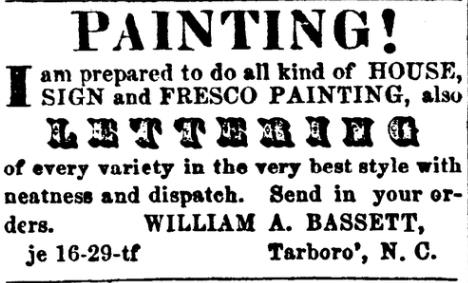 Enquirer southerner, Tarboro, North Carolina, Saturday, August 25, 1866
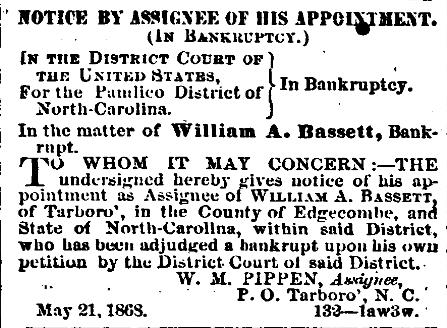 Tri-weekly standard, Raleigh, North Carolina, Thursday, June 4, 1868