
Benjamin Harrison Bassett descends from #5B William Bassett of Virginia as follows:
William Bassett (b. 1604) and wife Bridget Cary
William Bassett (b. 1671) and wife Joanna Burwell
William Bassett (b. 1709) and wife Elizabeth Churchill
Priscilla Bassett (presumed Great grandmother based on all current evidence)
Benjamin Carter Bassett and wife Martha Davis
William Henry Bassett (b. 1796) and wife Eleanor O’Neill
Benjamin Harrison Bassett and wife Mary Burnett Bassett
Mary Burnett Bassett’s line is as follows:
William Bassett (b. 1709) and wife Elizabeth Churchill
Burwell Bassett (b. 1734) and wife Anna Maria Dandridge
John Bassett (b. 1765) and wife Betty Carter Browne
George Washington Bassett (b. 1800) and wife Betty Burnet Lewis
Mary Burnett Bassett (b. 1839)
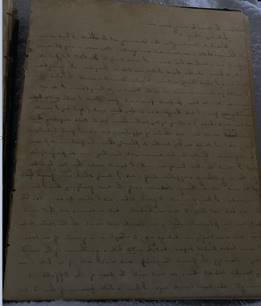
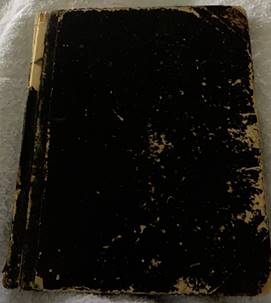 Pictures of the Benjamin Harrison Bassett Diary provided by Carol Williams
 The 2020 Debut of an Antebellum Relic
Important 1853-1855 Benjamin Harrison Bassett Diary Proudly Brought Out of Obscurity
By William Bassett Orr
It wasn’t that Benjamin Harrison Bassett’s fading 133,000-word diary from 1853-1855 miraculously survived the ravages of time in a forgotten box or in some other forgotten place and was only just recently discovered. It was that a certain line of his descendants lovingly preserved it for more than 125 years after his unexpected death on July 16, 1893, and it was only just recently that one of them finally took on the Herculean task of painstakingly transcribing it into type in hopes of preserving it for all time.
The words I’m writing now constitute the first public announcement of the diary’s existence. No other articles have been written about it; no university press or any other publishing house is yet aware of it. I’m aware of it only because Benjamin Harrison Bassett was the beloved brother of my great-great-grandfather Thomas Jefferson Bassett and because the transcriber, Benjamin Harrison Bassett’s great-great-granddaughter Carol Williams, kindly shared it with me owing to our common interest in our Bassett ancestry. The two brothers were very close; they lived parallel lives. They were both born and raised in Louisiana; they were baptized on the same day and in the same church; they both attended St. Charles College in Grand Coteau, Louisiana; they both attended Yale Law School, graduating in the same year despite a two-year difference in their ages; they both moved to Brenham, Texas, before the Civil War. They practiced law together; they both served in the war on the side of the South; for some 20 years after the war they owned and operated a bank together called Bassett & Bassett Banking House.
I’ve read the diary not once but twice and what a wonderful read it is. Ben was only 21 when he began it on January 1, 1853, at the start of his and Jeff’s final semester at Yale. It was a tense time in American history – a watershed moment marked by terrible divisions over Negro slavery and states’ rights. Harriet Beecher Stowe had just published her anti-slavery novel Uncle Tom’s Cabin, further inflaming public feeling, and the social divide would grow still wider just 16 months later with passage of the controversial Kansas-Nebraska Act allowing the spread of slavery into the Western Territories. Nowhere in his diary would Ben shrink from the great issue of his day; he would confront it head-on, again and again, as a Southerner living in the North, as a law student bristling with ideas of his own, as a struggling young lawyer after his return to the South. In it Ben would play out an unremitting war between opposing sides of his own psyche — between, on the one hand, his honesty about slavery’s flaws and his humane impulses and, on the other, his love for the South and the pull of his Southern roots. And always governing his evolving attitude on slavery would be his love of the law and a keen instinct for compassion and justice and logic and evenhanded analysis.
Thursday, January 12, 1854:
My feelings were lamented by the sight today; it was the sale of a poor old couple, man and wife, the one 70, the other 64 years of age, both wrinkled and gray, who had lived together all their days and now were sold asunder. It was one of the most heart touching scenes I ever witnessed. That old man walking in agony through the crowd with tears streaming down his black face, wringing his hands and mourning, uttering his few, short, but eloquent words with those ‘tears in his voice’ that Lamartine tells of. Oh, there must be something brutalizing in an institution which can so far degrade even a sensitive heart as to make it callous by incivility with a scene like this! The old man’s countenance, his gesticulation, his short ejaculated sentence, rugged and uncouth it may be, yet eloquent, because they came from the heart and were a study for an orator. They were a study too and a reproof to the man who justified slavery on any other principles than because it has fastened itself upon the vitals of our state and because they dare not remove it! This poor old negro, while his wife was being sold, without a purpose that I could perceive, besought the people not to buy her. ‘Gentlemen, she’s not worthy of your money, she’s old, sixty four years of age and full of pains, gentlemen don’t buy her, she’s not worth your money!’ His grief had blinded him, he saw only that if she were sold, they would be separated; forgetting that whether sold or not, she would have a master who in all probability would not be his master. And yet there were those who, they tell us, do not feel as the white man feels, who grow callous to the pangs of separation because they are familiarized with the thought from their early years. It is false! They do feel, and feel keenly too! But even were it so, how dare you justify a system whose tendency you avow is to make brutes of the beings God intended for men. No, no, no, no! Slavery in the abstract has no justification!
Ben’s diary shows him to be no ordinary young man; he is a good-humored ethicist, an unswerving believer in the power of civility and the rule of law. He doesn’t drink, he doesn’t smoke, he doesn’t gamble, he doesn’t swear; he doesn’t even chew tobacco. He reads and writes and thinks and observes and talks and listens and then he reads and writes some more. He is especially fond of Dickens; he sometimes reads him aloud, and whether its the fluency of Dickens that animates his pen, turning him into a gifted writer in his own right, or something else, it only takes until the second sentence of the very first entry for the reader to feel he’s in the hands of a writer gifted beyond his years.
January 1, 1853: This day, New Year’s, has been as dull to me as my worst enemy could wish it.
And also indicative of Ben’s talent as a writer is that many of his observations, even on serious topics, are not without a note of humor.
July 10, 1853: Jeff read [Uncle Tom’s Cabin] yesterday and today he is half an abolitionist.
But there’s also an endearing pathos running through the diary, especially regarding the death of their mother just seven months before their arrival at Yale.
Sunday, October 9, 1853: This is the [second] anniversary of my mother’s death, the saddest event that ever clouded my life!
And it’s hard not to think the prism through which he sees the world is deeply colored by his mother’s death. In one of my favorite passages Ben is in Georgetown, just outside Washington, visiting his mother’s cousin Ann Maria O’Brien Fulton shortly after graduating from law school. Ann Maria is now a nun, having lost her husband years before. Also, instead of calling her cousin Ann,” Ben endearingly, and confusingly, refers to her as his aunt, using the nomenclature “Aunt Fulton.” And accompanying Ben to Aunt Fulton’s is his brother Carter instead of his brother Jeff.
August 6, 1853: Reached Washington this morning at 6 o’clock and took rooms at Brown’s Hotel, accommodations good. My room is very pleasant, a front one, both are low down. I went early to see Mr. Fitzpatrick in order to learn whether Aunt Fulton was still in Georgetown. The young ladies came in and I stayed nearly an hour. Carter, meanwhile, was at the Patent Office. I called for him and we went on in the Omnibus to Georgetown. I do not remember ever to have prepared for a visit from which I anticipated more unmitigated pain. I had thought to see in my dear aunt (yesterday I would not have said dear) nothing of my mother’s cousin but the cold unfeeling nun whose vows must sever all the ties of affection, but when I first laid eyes on her, oh! I could see my mother so plainly there, her features and person, her expression, her smile, her manner and oh, everything was so perfectly alike that I cried the whole time of our visit. I do not wonder that Ma loved her for she is gentleness and affection itself and I surely shall never cease to love her or forget this visit, which though sad was one of the most gratifying that I have ever made.
The diary is written in two parts and one of Ben’s main refrains in Part One is his love for his fiancé, his cousin Ella Bassett of Clover Lea Plantation, 12 miles northeast of Richmond. Always during his time at Yale he’s thinking of her or writing her or desperately longing for more and longer letters from her. But even in Part One there are hints of trouble in their relationship, particularly in his dispiritedness when he doesn’t receive an expected letter from her. What Part One also makes clear is Ben’s rapport with Ella’s younger sister Mary, whom he refers to as “Bunny” while visiting at Clover Lea immediately after his and Carter’s trip to Washington. “[Bunny] is witty and is fond of teasing,” he writes three days before her 14th birthday on August 12, 1853. And again nine days later: “Bunny is always witty, she is my favorite after Ella.” And it is doubtless Bunny that is one of “the girls” that runs around the house “making very merry” with a recent daguerreotype of himself, causing him to write, “Really I shall have to destroy it.” His relationship with Bunny is playful; it’s platonic; she’s still very young. It’s Ella he is romantically in love with, but in the entirety of Part Two Ella mysteriously disappears until Ben makes a terse and startling entry making it clear their engagement is over.
Sunday, July 22, 1855: No preaching in town this day, and we have passed it not altogether unlike the working days of the week. I wrote another fragment to Sis, and then sent a terming envelope, pregnant with a litter of scraps. Wrote also a curt epistle to Ella, enclosing her ring, and requesting her to forward mine to Brenham. Also to burn any letters of mine she might have, and requesting directions as to the disposition to be made of hers.
What occasioned their breakup Ben does not mention, and though he doubtless doesn’t know it while in the throes of his anguished love for Ella, it would be Bunny that he would join in matrimony five and a half years later on the very day South Carolina would become the first state to divorce itself from the Union in the run-up to the war. Another thing Ben does not mention in his diary is that he is a descendant of more than a few of the first families of Virginia, including the Bassett family of Eltham Plantation, New Kent County, Virginia, with whom George and Martha Washington’s families would repeatedly intermarry, and the famous Harrison family of Berkeley Plantation, Charles City County, Virginia. I felt I knew why he didn’t mention it – because, according to newly discovered evidence, his paternal grandfather was born out of wedlock. Ben’s father was a sea captain named William Henry Bassett, and according to family lore he was somehow closely connected to President William Henry Harrison and his parents, the signer Benjamin Harrison V and Elizabeth Bassett of Berkeley, but no one knew how. The mystery of how William Henry Bassett was connected to the famous Harrisons persisted unbroken until three DNA tests would show, to everyone’s surprise, that he and his father were Harrisons. It now seemed that William Henry Bassett’s mystery father was a Harrison instead of Bassett, but other newly discovered evidence, including the signer’s will, would show he was both. He was Harrison by his father and a Bassett by his mother and, according to a synthesis of all the evidence as Carol and I understood it, the most likely Bassett to be his mother was Elizabeth Bassett’s sister Priscilla and the most likely Harrison to be his father was the signer’s brother Robert. The closest Ben comes to the topic of his Bassett and Harrison ancestry in his diary is his explicit characterizations of the Bassetts at Clover Lea and the progeny of President William Henry Harrison in southern Ohio as his cousins. The father of the Clover Lea Bassetts is George Washington Bassett, grandson of Elizabeth Bassett’s only surviving brother, Burwell Bassett Sr. of Eltham. And it is their Harrison cousins in the Cincinnati/North Bend area of Ohio that Ben and Carter visit immediately after leaving their Bassett cousins at Clover Lea. And, fittingly, among the things that happen during their stay with their Harrison cousins is another ill-starred courtship – this one involving Ben’s brother Carter and Mary Jane Harrison, “Cousin Jennie,” sister of the future 23rd president, “Cousin Ben.” But here, too, unfortunately, much is left to the reader’s imagination as our Ben again discreetly refrains from recording everything he knows. Also upsetting Ben’s equilibrium in the year of his falling-out with Ella is the rise of “Know-Nothingism,” an American nativist movement hostile to immigrants, particularly Catholics and Jews. Ben’s Irish-American mother had raised him to be a devout Catholic, and again and again he writes disapprovingly of the Know-Nothing Party after moving to Brenham.
Thursday, Oct. 19, 1854: By this morning’s mail, we received two letters from Pa and one from Cousin Fannie. The two former were written on the way to Memphis and one of them contained $50, which we ought not to keep and shall return. Received also a package of “know-nothing” journals, some of which we have read. They are the most scurrilous production I have ever seen; and the man who avows such principles as there is dangerous indeed.
Part of the problem is how the Know-Nothing Party wraps itself loudly in the American flag while professing quintessentially undemocratic principles; the Know-Nothing Party, for certain people, does not believe in equal justice under the law. But Ben’s apprehension over the rise of Know-Nothingism abates when the election returns finally come in showing “the Democrats have been much more successful” than the first telegraphic dispatches led the citizenry to believe. “In this state, democracy has triumphed everywhere,” he writes, “and the Know Nothing faction will never again, I hope, rear its guilty head with any hope of success.” But as drawn as he is to the politics of the day, Ben is also drawn to nature as an escape from the world of man. He is a keen observer of nature. And though the diary does show him hunting from time to time with Carter, more characteristic of Ben is that when he is alone he pauses before various flora and fauna intent on really seeing them. He befriends a squirrel in the woods; he is always flattering the moon, as he himself might put it. He is enriched by nature, in an age when there is still an abundance of nature, and in soaking in the imagery of his words the reader becomes enriched by the natural world too.
Wednesday, September 7, 1853: I took my position about sunset on the stern of the boat and watched first the waning splendor of the day, when the whole of the gorgeous west had robed itself in gold and pink and rose and vermillion and that other colour which I admire more than rose, and when these had almost faded away, directly between the steamer’s chimney appeared the modest new moon now four or five days old; and near the horizon, fast following in the train of the sun, was seen the evening star, then one by one came peeping forth the silver stars, like shining jewels on the robes of the eternal. Till this evening I never observed how the new moon appears to hold the old moon in its lap. I have seen that idea somewhere or other. It was two hours or more before I came below, for my thoughts were [more] pleasant than the society of any of my fellow passengers, for I was thinking of her, and were the night as long as a Greenland night, and as lovely as this, I could sit in its quiet but eloquent presence with no comparison but my own thoughts of Ella.
It’s my cousin Carol’s avowed feeling that Ben’s diary is too good to remain unknown to the world forever. I couldn’t agree with her more. For one thing, it is a beautifully written diary, something of a literary gem, especially for someone so young. For another thing, it’s a very good window on the life of a young Southerner struggling with the inhumanity of slavery after reading Uncle Tom’s Cabin while living in the North. And it’s also a touching story of love and heartbreak and family and individual growth through self-cultivation in a time of great uncertainty and conflict. But in some ways it’s also a story of the psychological and moral growth of an entire nation, and in his own growth it is the storyteller himself that becomes the representative man of the nation as a whole.