
Herbert James Bassett descends from #130B Richard Bassett of Claybrooke as follows:
Richard Bassett of Claybrooke, Leicester, England
Richard Bassett (b. 1621) and wife Ann
Richard Bassett (b. 1660) and wife Elizabeth Moore
Richard Bassett (b. 1690) and wife Mary Osborne
Richard Bassett (b. 1739) and wife Ann Freer
Richard Bassett (b. 1772) and wife Elizabeth Lawrence
Charles Bassett (b. 1811) and wife Comfort Tansur
James Bassett (b. 1834) and wife Jane
Herbert James Bassett
The Midland Daily Telegraph, Wednesday, May 31, 1933
Death of Supt. Bassett
Deputy Chief Constable of Coventry
Thirty-Six Years Police Service
City Loses Popular and Efficient Officer
We regret to record the death of Superintendent Herbert Bassett, M.B.E., Deputy Chief Constable of Coventry, who passed away at his home, Raleigh Road, Stoke, early this morning. Superintendent Bassett first encountered signs of impending illness about a year ago, and spent several months in a Birmingham nursing home, where he survived a serious operation, and was able to return to duty, but complications set in, and his condition had been the cause of anxiety for several weeks past. He was 58 years of age.
One of the most popular officers ever associated with the Coventry City Police Force, Deputy Chief Constable Bassett not only enjoyed the affection of his men but even earned the friendship of many of the offenders for whose convictions he was directly responsible, and in this connection many of his experiences were unique in police annals.
PRIDE OF TRADITION
Possessing an immense pride in the traditions of his profession, Deputy Chief Constable Bassett fostered them to the fullest extent throughout his career, and he possessed a flair for maintaining the high degree of discipline for which the City Police Force has become known without sacrificing a fraction of the friendly relationships existing between himself and the men under his control. He possessed the complete confidence of the Chief Constable (Captain S. A. Hector), as he had also enjoyed that of the late Chief Constable William Imber, and in no smaller degree that of the members of the Watch Committee.
Superintendent Bassett’s popularity was equally pronounced among the citizens as a body, who appreciated the unfailing courtesy with which he carried out his often difficult duties. His cheerfulness and good humour were rarely absent from his make-up, and few things in his life disturbed his equanimity to a greater degree than the findings of the Royal Commission on police procedure following a certain well-known case some three years ago. Superintendent Bassett felt that the restrictions then placed upon police officers in making inquiries were calculated to hamper seriously the work of crime detection.
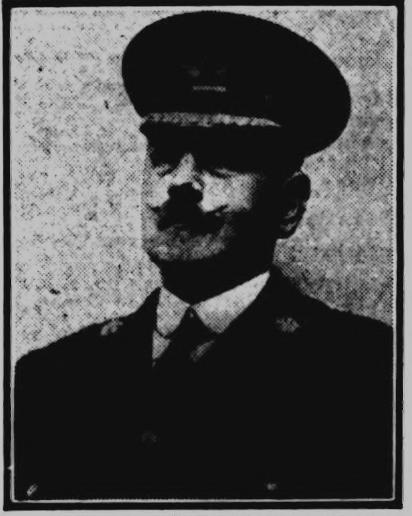 AN EXPERT RAILWAYMAN
But for a sudden desire to join the police, Mr. Bassett might have finished his career in an equivalently high position in the railway world. When a lad he was taken into the employ of the London and North-Western Railway and worked in the locomotive fitting shops at Rugby. A very high standard of ability and conduct was demanded of the apprentices, and he often used to say that the discipline on the railway was as rigid as in the police force. By the time he had finished his shop training he could have undertaken any job on a locomotive.
He next became a fireman, first on goods and then on express trains. There was no eight-hour day. Mr. Bassett would recall the long periods he had on duty, twelve and sometimes fourteen hours. He was soon firing the engines on expresses between Rugby and London and Rugby and Crewe. The drivers in those days were aristocrats of their profession. One man for whom he fired always wore a bowler hat, frock coat, and starched collar and cuffs – yet he always reached his journey’s end as spick and span as when he started. Mr. Bassett’s last run was on the footplate of the Scotch Express.
TURNED DOWN AS A POLICEMAN!
After nine years as a railwayman, Mr. Bassett felt a keen desire to join the police, though it would mean an immediate drop in salary of 12s. per week. On a day off he visited Warwick and saw the late Superintendent Gleed. The latter blankly refused to enlist him. “You would be tired of the police in a month,” he said. His enthusiasm still undamped, Mr. Bassett went to Coventry, and was welcomed by the late Chief Constable Gray with open arms. “Can you bring me another twelve men of the same type?” he asked. Mr. Bassett used to chuckle as he recalled the medical examination which followed. All the doctor did was to admire his physique, ask him a couple of quite haphazard questions, and pass him! It is a peculiar fact that the railway company never gave him his discharge. His superiors were so annoyed that they refused to discharge him, doubtless in the hope that someday he would return. But he was destined to make such progress in his new profession that the day was to arrive when, after he had conducted a case at Warwick Assizes, he was mournfully told by Superintendent Gleed, “I wish I had taken you on.”
RAPID PROMOTION
Mr. Bassett was born at Brownsover, near Rugby, on October 12th, 1874. It was in 1897 that Mr. Bassett first donned the uniform of a constable of the Coventry City Police Force, and for two years he had an opportunity of ruminating upon the wisdom of his choice while patrolling the streets. Any doubts he may have entertained were largely dispelled when he was appointed to the detective department, and here his ambition soon began to bear fruit. He had found his vocation. In 1905 he was promoted detective sergeant, and in 1906 detective-inspector, remaining in charge of the detective department until March, 1919, when he was made superintendent. He was appointed Deputy Chief Constable in 1832. In January, 1932, Superintendent Bassett was appointed a Member of the Order of the British Empire for this police services. He had many commendations, including one from the Postmaster-General in 1922, and one from the War Office in 1918 in recognition of his services in assisting the administrative of the Defence of the Realm Act.
SECRET SERVICE WORK
This latter commendation had reference to work of a secret service character carried out by Mr. Bassett during the War, and concerning which he was naturally reticent, but as chief of the detective department all secret police inquiries naturally came under his supervision. He carried out a far greater volume of work of this kind than is generally realized. By no means the last exacting part of Superintendent Bassett’s work during the War and post-War period was that of dealing with the serious trade disputes which arose. It was here that his charm of personality found its full scope. Strongly opposed to the use of force, Superintendent Bassett found it more effective to gain the confidence of the men with whom he was dealing, and he succeeded in doing this with remarkably good results. His policy of peaceful persuasion, backed by transparent honesty of purpose, gained him the friendship of men who were scarcely well disposed towards the forces of law and order.
A DIFFICULT SITUATION
While acting as a detective officer Mr. Bassett handled two murder cases, both of them containing some remarkable features. In one instance an elderly local baker was found lying dead in this bakehouse. The doctor then acting as police surgeon examined the body and came to the conclusion that the man had had a seizure, and that in falling his head had struck an iron spike, and had pierce his brain. Mr. Bassett was unaware that his conclusion had been arrived at, or that the medical man had submitted his report. He examined the bakehouse and arrived at a different conclusion. Imagine the consternation at headquarters when the detective brought in a man on a charge of murdering the old baker! Mr. Bassett was even snubbed for making what was regarded as an absurd faux pas. The consternation subsided when the prisoner was found “Guilty” at Warwick Assizes and was ultimately executed.
FRIEND OF WRONG-DOERS
On another occasion an old lady was found dead, and a medical practitioner formed the conclusion that she has succumbed to heart failure and old age. This was equally unfortunate for Mr. Bassett, who had formed the conclusion it was a case of murder. A the risk of further official complications the detective arrested a son, who was found guilty and sentenced to life imprisonment.
Nothing has been more remarkable than the friendly relations Superintendent Bassett maintained with many of the wrong-doers whom he has arrested and arraigned. He was probably one of the few policemen who received a mourning card from the family of a man whom he arrested and who was executed as a result of his evidence. For a number of years he received regular friendly greeting from a “tough nut” who had been through his hands, and who subsequently wandered into some of the most remote parts of the world.
Superintendent Bassett leaves a widow and one son. The funeral will take place at Stoke Church on Friday at 2.45.
Magistrates’ and Solicitors’ Tributes
Sympathetic references to the death of the Deputy Chief Constable were made before the ordinary business of the Coventry City Plice3 Court was started today.
Mr. A.L. Bill, who was in the chair, said that Mr. Bassett’s great amiability of character had endeared him to every member of the public as well as to his colleagues in the police force. His ability in his profession, said Mr. Bill, had earned for him the recognition of His Majesty the King.
“The city, the Force, and this Court are all the poorer for his passing, and I feel we cannot let this occasion pass without showing that we sympathise with those he as left,” concluded the Chairman.
A moment’s silence, with the court officials and members of the public standing, was observed, and then Mr. S.F. Snape rose to add a tribute on behalf of the solicitors practicing at the court.
Mr. Bassett had always been faithful and assiduous in his duties, said Mr. Snape, but he also possessed a very human side to his nature. He possessed the kind of personality which it would be well for not only police officers but for all others to emulate. He would be sadly missed in the courts.
Everyone, said Mr. Snape, admired the fortitude and bravery with which the Deputy Chief Constable had faced the illness which he had so long suffered.